
For candy and gum brands, mint tins are more than just a container. In the right format, they help protect the product, improve portability, support repeat use, and create a stronger shelf presence. That is why metal tins continue to be widely used for breath mints, chewing gum tablets, pellet gum, and other small-format confectionery products.
The challenge is that choosing the right mint tin is not as simple as picking a shape and adding a logo. A tin that looks attractive in a catalog may not be the best choice for filling, dispensing, shipping, retail display, or daily use. In real projects, the better result usually comes from getting the basics right first: product fit, lid structure, material logic, decoration method, and development route.
This guide is written for candy brands, gum brands, private label buyers, and distributors who want a more practical way to choose custom mint tins. Instead of looking at packaging only from a styling point of view, it focuses on how mint tin projects actually work in sourcing and production.
Mint tins remain popular because they combine protection, convenience, and presentation in one compact format. For small dry confectionery products, packaging usually needs to do three things well: keep the product safe during transport, feel easy to use in everyday life, and look distinctive enough to support branding.
Compared with soft pouches or lightweight cartons, a metal tin offers a more stable structure. This matters for products that are carried in pockets, handbags, travel kits, and car compartments, and it also matters in export shipments where packaging may go through repeated handling before reaching the shelf.
Mint tins also have a longer branding life. Consumers often keep them long after the original product is finished, which means the packaging continues to work as a visible brand touchpoint. That is one reason tins remain attractive for both retail products and promotional use.
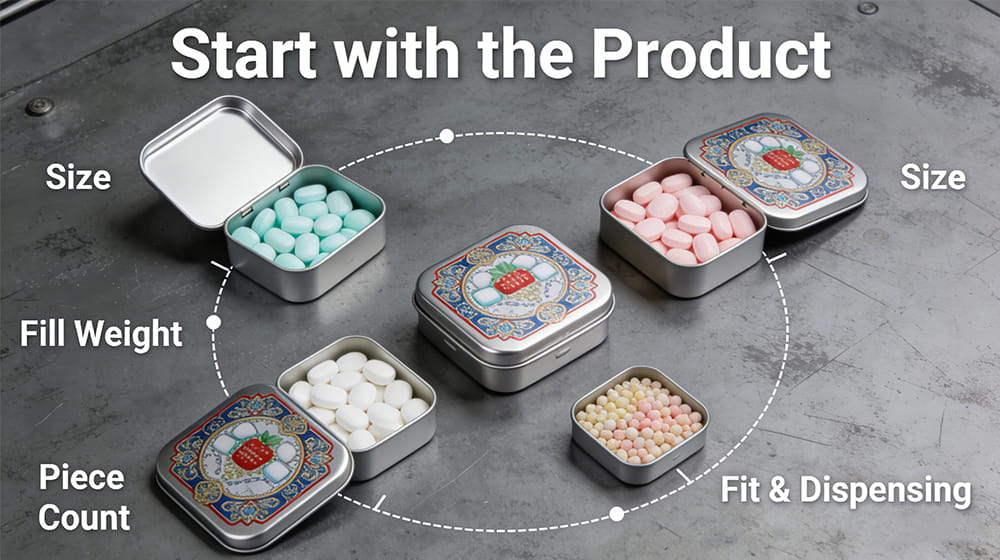
One of the most common buying mistakes is choosing the structure too early. Many buyers begin with a visual preference such as “we want a slide lid” or “we want a hinged mint tin.” In practice, the better approach is to start with the product itself.
Before selecting a structure, confirm these points:
| What to Confirm First | Why It Matters |
| Product dimensions | Determines whether the product fits and dispenses properly |
| Fill weight | Affects internal volume and carton efficiency |
| Piece count | Helps define the most practical opening style |
| Daily use scenario | Influences whether hinged or slide lid is a better fit |
| Retail channel | Affects branding area and perceived value |
| Budget and launch timing | Helps decide between an existing mold and new tooling |
When buyers start with the product, the packaging decision becomes more practical. It also reduces the risk of discovering too late that the opening style, internal clearance, or pack feel does not suit the confectionery.
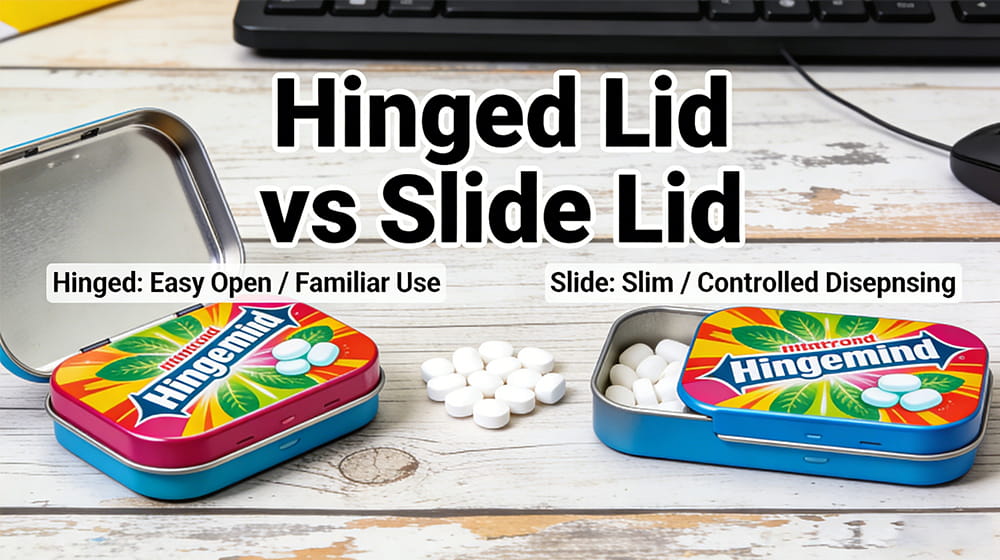
Hinged tins are one of the most widely used structures in mint and gum packaging because the lid stays attached and the opening motion feels familiar to consumers. They are often a practical choice for chewing gum tablets, pocket mints, and other products that are opened repeatedly in everyday use. TinBoxesChina’s public Mint & Gum category shows hinged lid options as one of the core structures in this segment.
Slide lid tins are often preferred when the brand wants a slimmer profile and a cleaner, more modern look. They work especially well for breath mints and compact candy packs where portability and controlled dispensing matter. TinBoxesChina’s Sliding Lid Tins page describes this structure as compact, stackable, and widely used in candy and mint packaging.
| Structure | Best For | Main Strength | What Buyers Should Watch |
| Hinged lid tin | Gum tablets, daily-use mints | Easy opening, attached lid, familiar use | Hinge feel, lid alignment, opening angle |
| Slide lid tin | Breath mints, slim promo packs | Compact profile, cleaner look, controlled opening | Slide tolerance, dispensing behavior, product fit |
In many projects, the best structure is the one that matches how the product will actually be used, not simply the one that looks best in a photo.
A lot of packaging language sounds similar across suppliers. Terms like “durable,” “food-safe,” and “premium” only become useful when they connect to real specifications.
TinBoxesChina’s public site repeatedly highlights food-grade tinplate and Pantone plus 4-color printing capability across its packaging pages. Its Mint & Gum product pages also present mint tins as portable, reusable, and suitable for confectionery packaging.
For buyers, however, the most important point is not only the material name. What matters is how the whole pack performs together: tinplate quality, forming consistency, coating suitability, lid fit, and printing quality. As TinBoxesChina explains in one of its packaging articles, price differences often come from less visible details such as tinplate grade, coating quality, and how precisely a mold fits during production.
That is why two tins that look similar in pictures may behave very differently once they go through filling, shipping, and repeated consumer use.
To make this guide more practical, here is one publicly listed hinged mint tin example from TinBoxesChina’s website.
| Model | Structure | Size | Hold Capacity | Material | Recommended Thickness | MOQ | Lead Time |
| JY-MT-01 | Hinged lid | 60 × 50 × 15 mm | 30 g | Food-grade tinplate | 0.23 mm | 2,500 pcs | 30 days |
This kind of standard format is often a practical starting point for buyers who want a compact, proven structure before moving into more customized development.
Buyers often compare quotations and assume the price gap comes mainly from order quantity or supplier margin. In reality, the difference is often more technical than that.
| Cost Factor | What a Buyer Usually Sees | What Actually Changes the Cost |
| Tinplate | “Looks similar” | Grade, thickness consistency, forming stability |
| Internal coating | “Inside looks the same” | Coating quality and suitability for product contact |
| Mold fit | “The lid closes” | Precision of lid-body fit and repeatability in bulk production |
| Printing | “It is just artwork” | Color control, finish complexity, registration accuracy |
| Decoration | “Simple embossing” | Tooling complexity, emboss depth, and layout limits |
| Tooling route | “Custom size” | Existing mold vs new mold investment and development time |
This is one of the most useful things buyers can understand early. According to TinBoxesChina’s own packaging insight article, differences in tinplate grade, coating quality, and mold fit precision are often what separates a low headline price from a more reliable packaging result.
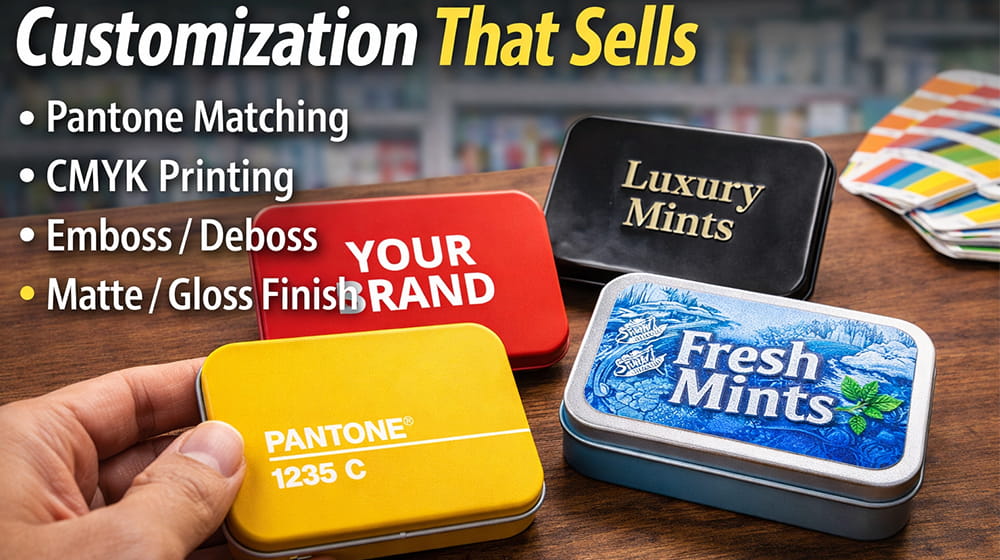
In a mint tin, space is limited, which means every design decision needs to work harder. Good customization is not about adding as many effects as possible. It is about making a small package feel clear, intentional, and well positioned.
The most commercially important customization points usually include:
| Customization Area | Why It Matters |
| 4-color / CMYK printing | Good for detailed artwork and colorful brand presentation |
| Pantone matching | Better for stronger brand color consistency |
| Matte or glossy finish | Changes shelf feel and perceived positioning |
| Embossing / debossing | Adds tactile value and improves memorability |
| Structure choice | Affects user experience as much as appearance |
| Existing mold selection | Saves time and cost if the fit already works |
TinBoxesChina’s site publicly emphasizes professional Pantone and 4-color printing machinery across its product pages, which is especially relevant for small-format tins where color accuracy and visual clarity have a big impact on shelf presentation.
In many confectionery projects, a compact tin with a strong lid feel, accurate color, and one clear branding element performs better than a small pack overloaded with graphics.
This is one of the most important commercial decisions in a mint tin project.
If a standard existing mold already fits the product well, it is usually the faster and safer route. It reduces tooling risk, lowers development cost, and shortens the timeline. This is especially useful for first launches, seasonal programs, and private label buyers testing a new line.
A custom mold becomes more attractive when the brand needs a very specific structure, footprint, or shelf presence that standard options cannot deliver. The right choice depends on the commercial goal, not only the design ambition.
TinBoxesChina publicly states that it was founded in 2008 and that its factory covers 35,228 square meters, with 10 standardized production lines, 15 fully automated production lines, and a monthly output of 3.5 million tin boxes. For buyers, this kind of public capacity information suggests a manufacturing setup built for repeat production rather than sample-only customization.
For most candy and gum brands, sourcing works best when the project is treated as a packaging development process, not just a quotation request.
We begin with the product itself: dimensions, fill weight, piece count, and intended use. A mint tin should not be selected as decoration first and packaging system second. The structure has to work with the confectionery in real use.
Once the product is clear, we narrow the structure options. For mint and gum projects, that usually means reviewing whether a hinged tin or slide lid tin is the better fit. If an existing mold can already achieve the required result, it is often the most efficient starting point.
At this stage, the technical layer is reviewed: tinplate choice, thickness range, internal coating suitability, surface finish, and likely lid behavior in bulk production. This is also where potential risk points become visible, such as poor fit, unstable opening feel, or decoration choices that do not suit the structure.
The artwork is then checked for metal printing layout, finish treatment, and embossing placement if needed. A pre-production sample helps confirm not only the visual result, but also the structure in hand.
After approval, the project moves into production and export packing. This is where factory consistency matters most, especially for repeat orders and cross-border shipping.
This section is different from the collaboration roadmap. The roadmap explains how a project moves forward. This part is about what buyers should evaluate before choosing a supplier.
A reliable mint tin manufacturer should do more than show attractive product photos. Buyers should look for a supplier that can:
recommend the right structure instead of only sharing catalog images
explain why one option is more suitable than another
provide clear material and specification logic
support sample review before bulk production
show evidence of repeat manufacturing capability
TinBoxesChina’s public site describes the company as a packaging customization enterprise integrating design, R&D, and sales, and it also publishes production scale information and category-based product offerings. Those are the kinds of signals many buyers use when assessing whether a supplier is operating as a real manufacturing partner instead of only as a trading-style listing seller.
Yes. Mint tins work well for chewing gum tablets and pellet gum, especially when the product is dry, compact, and intended for repeated opening and closing.
Neither is always better. Hinged tins are often preferred for familiar daily use, while slide lid tins are popular for slimmer pocket packs and a cleaner look. The better choice depends on the product size, dispensing style, and brand positioning.
They can be, provided the tinplate and internal coating are specified correctly for food contact use. Buyers should always confirm this with the supplier for the actual product application.
In many cases, yes. If an existing mold already fits the product, it usually saves time, reduces tooling cost, and lowers development risk. TinBoxesChina’s own article on cost and MOQ also notes that standardized models can help lower cost and shorten production time.
The main factors usually include structure, tinplate quality, internal coating, printing and decoration complexity, and whether the project uses an existing mold or a new custom tool.
The right mint tin does more than package a small candy product. It affects product protection, portability, retail presentation, repeat use, and overall brand perception.
For candy and gum brands, the best tin is rarely chosen by appearance alone. The better decision comes from balancing product fit, structure, material logic, decoration needs, and production efficiency. A hinged tin may be the right answer for one project, while a slide lid tin may be better for another. What matters is not which format sounds more premium, but which one actually works better for the product, the consumer, and the selling channel.
A strong buying guide should help readers think like buyers, not just browse like shoppers. That is why real reference points, structure comparisons, and a clear development roadmap make this topic more useful and more persuasive.
Obtenga la información más reciente y ofertas especiales


 Soporta red IPv6
 Español
 English
 Français
 Deutsch
 Português