
The biscuits are asked to sell themselves to the window lid. The artwork does that job for a solid cover.
That sounds like a design decision. In fact it goes so much further than that.
A transparent window allows you to see the decorated cookies, colorful assortments and unusual shapes immediately. It may also present a crumpled inner bag, an oversized tray cavity, or a trail of crumbs left after transport.
A solid lid provides the designer with a full metal surface and prevents light from passing through the top of the pack. Yet it conceals a product that could have sold itself. Nor is it automatically airtight.
For a window lid inquiry we always start with the production cookie dimensions and the final pack arrangement. An empty tin or a digital rendering rarely provides the buyer with the information needed to make the right decision.
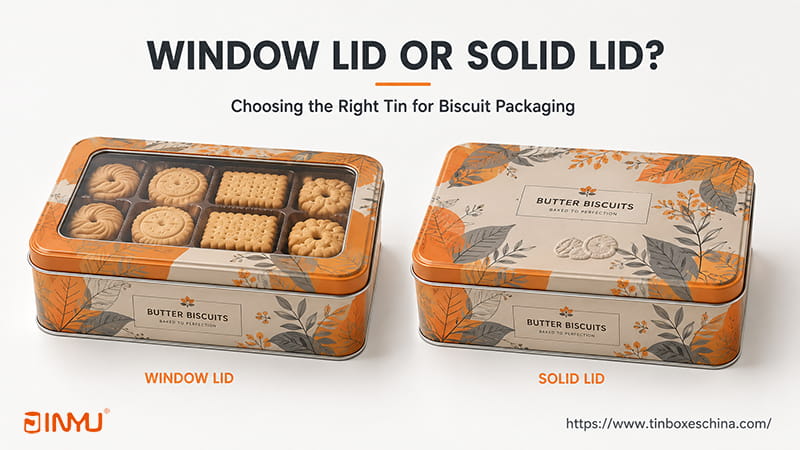
A window is a window if the product has real visual value: decorated icing, distinctive shapes, attractive colors, or a carefully arranged assortment.
If the biscuits are ordinary looking, or are very variable in production, or produce a lot of crumbs, then a printed solid lid may present them better.
Don't judge the window before the tray, paper cups, inner bag and heat seal are in place
They are all displayed in the window.
A clear bag can create glare. Paper cups can cover the edges of the biscuit. A tray selected from perfect sample cookies can have visible gaps around normal production pieces.
The solid lid panel does not allow light to pass through. Some light can reach the product through a window, unless it is blocked or filtered by another packaging layer.
The importance of that difference will depend on the biscuit recipe, colorants, retail lighting, storage period and inner packaging.
If the product is sensitive to moisture or oxygen, the protection is usually provided by the sealed inner bag, not by the appearance of the lid.
Solid lid does not mean air tight seal. A window lid is not a leak point by default.
Pick a window when the real product should be the star of the show.
Choose a solid lid if a seasonal illustration, embossed logo, corporate design or collectible gift message deserves the full lid surface.
If both options still look good after asking these five questions, then make a fully packed sample of each. Often, the answer is much clearer side by side.
A window lid is normally a metal lid with an opening and a transparent sheet attached beneath it. The transparent part can be PET or other material suitable for the construction and target market.
The window can be of a round, rectangular, oval or custom shape. It could be a small area in the middle or it could cover most of the lid face.
The solid lid is made of tinplate only and does not have a clear opening. It offers a continuous metal surface for printing, varnishing, embossing, debossing and metallic effects.
Neither term applies to the way the tin closes.
A window lid can be closed in different ways as well as a solid lid.
This is an important difference. The lid panel is called “window or solid”. “Slip, plug or hinged” is the fit or attachment of the lid to the tin body.
| Factor | Window Lid | Solid Lid |
| Product visibility | Shows the actual biscuits and pack layout | Hides the product until opened |
| Branding area | Window reduces available metal print area | Full lid available for artwork and finish |
| Light exposure | Allows some light into the product | Blocks light via the lid panel |
| Protection against moisture and oxygen | Usually depends on the complete construction and inner pack | Also depends on the complete construction and inner pack |
| Structural design | Adds a transparent, openable component and a method of attachment | Uses a single metal panel |
| Quality control | Consists of clarity, dust, scratching, alignment and attachment | Mainly looks at printing, forming, lid fit and deformation of the metal |
| Cost | May add window material, tooling, assembly and inspection | Usually easier when existing solid-lid structure is available |
| Documentation | May add film and attachment-material requirements | Still requires applicable tinplate, coating and print documentation |
| Recycling assessment | Must be assessed together with metal, window and attachment method | Simpler material structure but the whole pack still needs assessment |
| Often suited to | Decorated cookies, visible assortments and bakery presentation | Gift tins, seasonal artwork and products in opaque inner bags |
These are tendencies, not certainties. Performance is based on actual tin, window area, closure, inner packaging, biscuit and export carton.
A window is an honest mirror. It doesn’t show the best part of the product only.
It shows the tray, paper cups, bag folds, heat seal, empty spaces and anything that shifts during transport. If something looks messy the window makes it visible.
We normally look at the window and the internal arrangement together. Approving one without the other often leads to avoidable rework.
Before you confirm the design, make sure:
Use the actual size range of production, not just a handful of hand-picked cookies. If the tray cavity and window frame provide a set visual reference, a variation of a few millimeters can be perceptible.
For a detailed comparison of packaging systems, see Cookie Tin Inserts Compared: PET Trays, Paper Dividers, Paper Cups and Inner Bags.
“Showing the food can also bring confidence because the consumer sees the real product and not a photo. But transparency is no guarantyd sales differentiator.
One study of transparent windows on food packaging, for example, found the response varied with product category, appearance and presentation. Visibility may be good for attractive foods, but not for less attractive products.
This is consistent with the practical reality of packaging a biscuit.
A neatly arranged choice of iced stars, flowers or seasonal shapes can be the strongest part of the design. A mixed lot of uneven heights, jagged edges or visible grease marks can look better behind a strong illustration.
And the sales channel is important too.
In physical retail, shoppers can inspect the product themselves, making window lids most convincing. In e-commerce, good photography can show both the closed tin and its contents, so the physical window may not add as much value.
Pick the window because it works well for the real retail pack, not because it looks good in a rendering.
The lid surface prevents light from penetrating a solid metal lid. A transparent window will not.
That difference should be considered when the product contains:
It can also depend on whether tins will be under bright retail lighting or near a shop window for long periods of time.
But light is only one thing. Oxygen, humidity, temperature, recipe, antioxidants and barrier properties of the inner bag also affect the product quality.
A study on biscuit storage to examine lipid oxidation and humidity absorption found that both could affect the texture of the biscuits. Other research has been done on changes in biscuit moisture, water activity, texture and oxidation under different packaging materials and accelerated storage conditions.
Neither study provides a universal rule for window lids. They suggest a more pragmatic conclusion: test the food that’s actually in the package.
There is no reliable rule that a window lid is safe up to a certain number of months and then a solid lid is needed. Two biscuits with the same shelf life target can behave differently.
The lid panel is "solid" It does not describe an actual barrier.
A standard slip lid or plug lid may feel tight, but can still allow slow moisture and air exchange. Buyers should not assume that the tin is a hermetic package without a specific sealing system that has been designed and tested.
If your product needs a specific moisture or oxygen barrier, ask:
A good window lid and good inner bag will do a good job of protecting biscuits. A solid lid cannot without a proper primary barrier.
There is also a simple business question. If the bag required is opaque or metallized, what will the shopper see in the window?
Most of the time it's just the bag. In that case, a solid lid may be the more logical choice.
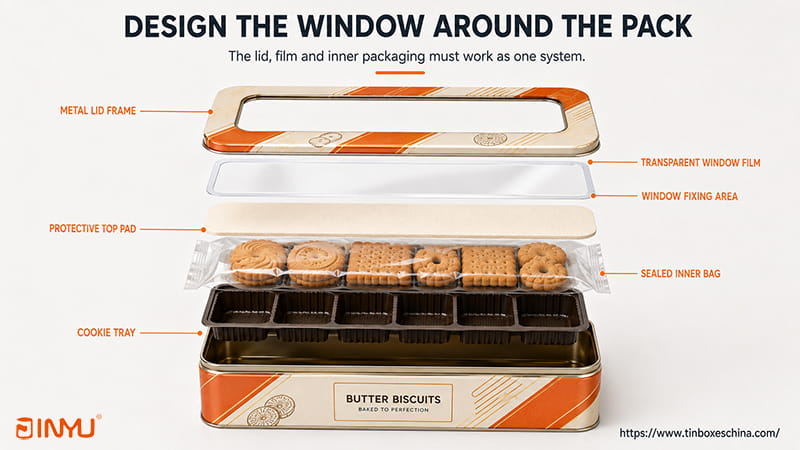
Do not increase a shape in the artwork to make the window larger. When deciding how large the window should be, consider the cookies and inner packaging.
The bigger the opening, the better the view. It also remains:
The engineering review shall cover window dimensions, corner radii, distance from rim, available metal border, lid curvature, attachment area, artwork registration and product clearance.
Pay special attention to sharp corners and tight metal spaces. The opening needs to be far enough from hinges, formed edges and embossed details.
A small central window can provide a useful product preview while saving more metal for structure and artwork. A larger window provides more shelf impact but requires a more consistent pack-out.
If you are unsure, don’t finalize the artwork. Design construction with lid drawing, window opening and visible tray area. Confirm them.
The window lid is not automatically a weak point. It just gives you more to worry about.
During sampling & production inspect:
Do not press the packed product continuously against the window. If a stuffed bag or tall cookie pushes up the transparent component, adjust the tin height, number of pieces or inner packaging.
In export work, test the packed carton rather than the empty tin. Checks relevant to the contents may include carton compression, drop testing, vibration, temperature changes, scratch protection and space above each lid.
A large window changes the load-carrying mechanism of the lid, but transport performance cannot be deduced from the window alone. All count, the rest metal frame, product weight, master carton and stacking plan.
If the window needs special protection, include that cost and carton space when deciding on the lid.
The product is integrated into the graphic design via a window.
The artwork could frame the biscuits, make a seasonal border or use printed elements that interact with the visible shapes. If done well it is more convincing than printing a photo of the same product.
The compromise is less metal.
Designer has more freedom for a solid lid:
Ask one simple question: "
What is the strongest visual asset, inside the tin or on top of it?
If the answer is the biscuit then the window is worth serious consideration.
In the case of brand artwork, the solid lid usually wins.
A window lid quote can contain:
A solid lid has less parts but isn't necessarily cheaper. Large-area embossing, special varnish, complex forming or new tools can also increase the price.
There is no good standard percentage that a window lid costs more. The difference depends on the size of the tin, the size of the window, the material, the method of production, the quantity ordered and any existing tooling.
Request supplier to quote both options against the same:
That comparison is much more useful than a general percentage.
Jinyu has more than 3000 existing molds and structures. We advise you to look at these options before you open a new window-lid or solid-lid mold.
For a more detailed cost breakdown, see "What Determines the Cost of Custom Cookie Tins?" A Buyer’s Breakdown of the Quotation.
A report of metal-tin is not automatically inclusive of the transparent window or the materials used to adhere it.
Notify the supplier:
Depending on construction, the compliance file may need to identify:
Documentation may be required under Regulation (EU) No 10/2011 for applicable EU plastic articles.
The FDA designates packaging components and substances such as adhesives intended for use in food as food-contact substances in the United States. See FDA guidance on food packaging and other substances that come into contact with food.
These requirements should be identified in quotation. Waiting for the tins to be ready to ship can slow down the project.
The solid steel lid is simpler in material structure than the metal lid with a transparent component. This may facilitate the recycling assessment but does not justify an automatic environmental claim.
Think of a window lid for:
The EU Regulation on Packaging and Packaging Waste identifies the separability of components, adhesives, closures and material combinations as relevant design-for-recycling concerns. See Regulation (EU) 2025/40.
Just because steel and PET might be recyclable on their own doesn’t mean a steel-and-PET lid is recyclable.
The product is in regular shapes and colorful decoration. Each cookie is in a cavity that matches the window.
The biscuits themselves carry the visual message so it is worth testing a window lid.
The tin needs a full Christmas illustration, an embossed logo and strong reuse value. The bag is already branded and the biscuits are not conspicuous.
A solid lid will probably be more efficient with the space.
The cookies will be different sizes naturally, but look good as a group. Paper cups organize the display without fixing each piece into a cavity.
A smaller window might offer a good compromise between authenticity and enough metal to brand. The decision should be taken after seeing the sample fully packed.
These aren't strict rules. They serve as starting points for sampling.
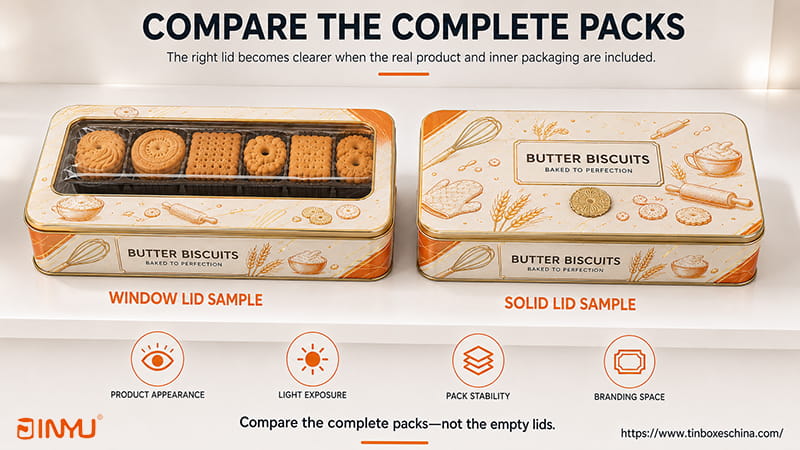
If the buyer is still indecisive, this is usually more helpful than another round of renderings.
Make one window lid sample and one solid lid sample using:
Then look at them from regular retail distance.
Test the packs response to handling and typical storage conditions. Review color, crumbs, movement, bag glare, window scratching, moisture, texture and other relevant shelf life indicators depending on product and QA plan.
If the light sensitivity is unknown, the buyer’s QA team may conduct a controlled comparison of the two pack structures and a suitable dark control. This screening can highlight differences but is not a substitute for formal shelf-life validation where needed.
Photograph each sample under identical light. The color differences could look bigger or smaller than they really are in photos taken on different days.
The point is not to do a complex experiment. That is to stop deciding out of an empty tin.
When asking a supplier to compare a window lid with a solid lid, provide:
MOQ for custom-printed biscuit tins at Jinyu is 5,000 pieces per size and design. Samples usually take 7-10 days. Once the sample and artwork are approved, mass production is usually 25-35 days.
Additional tooling, lab testing, or special packaging can affect the schedule, so identify those requirements early on.
Not by default. Shelf life is affected by moisture transfer, oxygen exposure, the inner bag, heat seal, and recipe and storage conditions. A window can affect the light exposure, but it is only one part of the packaging system.
Not at all. A regular slip lid or plug lid can seem tight without making a hermetic seal. Use proper sealed inner bag when product requires defined barrier.
PET is a possible material but the specification changes. Ask the supplier to confirm the specific material, thickness, method of attachment and any food contact documents that are applicable.
This can be due to the addition of a transparent component, fixture, tool, assembly and inspection. For the particular construction the actual difference must be quoted.
Yes. Check a transparent bag for glare, folds and seal position. If the bag is opaque, ask yourself if the window is still helpful for showing off the product.
Yes, they can. Test fully packed carton and check window area, remaining metal frame, product clearance, master carton and stacking conditions.
Select a window lid when the actual cookies are to be incorporated into the packaging design.
If the artwork, uninterrupted metal surface, light exclusion and material simplicity should guide the presentation choose a solid lid.
No decision should be made on the basis of an empty sample.
Give Jinyu your biscuit size, tolerance, packs per carton, inner packaging, destination market and artwork direction. Before you commit to new tooling or printed samples, we can examine suitable window-lid and solid-lid structures from our existing mold library.
Learn more about our custom cookie and biscuit tin boxes or contact us to discuss your packaging design.
Obtenga la información más reciente y ofertas especiales


 Soporta red IPv6
 Español
 English
 Français
 Deutsch
 Português