
Custom tin packaging often gets referred to as being durable, reusable, premium and recyclable. These are real benefits but they don't guarantee success in any given tin box project.
A custom tin package is only effective if it fits the product, protects the contents, supports the brand, fits the budget, and can be manufactured reliably.
The most important question for packaging buyers to ask is not just:
“Can we print our logo on a tin box?”
A better question is
How do we take our product requirements, and turn that into a metal packaging solution that works in a production environment, shipping environment, retail and customer environment?”
The article deals with the practical decision-making aspect of planning custom tin packaging.
Many custom tin box projects originate from a visual idea.
A brand may want a round tin, a heart shaped tin, a vintage tin, a matte black tin or a tin with embossing and metallic printing. These ideas may be helpful but should not be the starting point.
The product should be the starting point.
The packaging may look good, but if the product requirement is not clear, it may fail in actual use.
Typical problems are:
Custom tin packaging should be designed as a complete system, not just as a decorative metal container.
This system includes product fit, protection, lid structure, printing, finish, inner packaging, mould selection, MOQ, sampling, quality control and shipping .
Before talking about shape, printing or price, buyers should answer five questions.
The product defines the real packaging structure.
Tea, coffee, cookies, chocolates, candies, cosmetics, candles, stationery and promotional products all act differently when packaged in tin.
Some products are delicate. Some are powdery. Some are moisture sensitive . Some require review for direct food contact. Some are sold as presents. Some are re-used after the opening.
The tin should be designed around these facts.
Different products are exposed to different risks:
A decorative tin may look better on the shelf, but protection is a function of structure.
Cookies, for example, may need space and liners to avoid breakage. Tea may require a pouch or plug lid inside to guard the aroma. Chocolate may require trays or dividers to prevent shifting. Cosmetics might require tight-fitting lids or liners to prevent leakage.
A tin is not opened once only. Many tin packages are opened and closed many times, stored and reused.
That affects the lid choice.
A hinged lid tin might be better for mints, small candies or reusable gift sets. Standard retail tins can have a slip lid. A screw lid might be better for cosmetics or small canisters. A window lid can help display colourful products, but it may not be the best for products sensitive to light.
The lid must be matching the UX.
Custom tin packaging can convey a variety of brand messages:
The printing and finish should show that message.”
Luxury products may use a matte finish with embossing. Bright glossy printing may do for holiday candies. Minimal typography is for premium tea. Metallic printing can be used for gift packing. Retro illustration may suit biscuits or holiday tins.
Good design is not about using every effect you can. It is about applying the right effect.
Each custom tin project is subject to production limits.
These can include:
A mockup with a design that does not take into account production reality may look impressive, but will be difficult, expensive or slow to produce.
First is product fit and then tin shape.
The shape of the tin is less important than how well the product fits.
But a tin can can be beautiful and wrong if the product does not fit properly.
Buyers should verify product compatibility for the following:
What counts is what’s inside.
For example, a cookie tin might need extra room for paper liners, but too much empty space can cause the cookies to shift and break. A chocolate tin may need a tray that reduces usable depth. By volume it may look like it is big enough, but loose leaf fluffy tea may need more space than compact tea.
Test the product fit with actual samples where possible.
Pick a custom tin that is compatible with what the product needs to survive.
| Product Category | Main Risk | Tin Packaging Logic |
| Tea | Moisture, aroma loss, light exposure | Use tight lid, inner pouch, plug lid or canister structure |
| Coffee | Aroma loss, oxygen exposure, premium display | Use canister-style tins or inner freshness protection |
| Cookies and biscuits | Breakage, movement, gift presentation | Use larger tins, liners, dividers or trays |
| Candy and mints | Repeat opening, portability, moisture | Use mini tins, sliding tins, hinged tins or slip lids |
| Chocolate | Heat, pressure, movement, surface damage | Use gift tins with trays, dividers, paper cups or pouches |
| Cosmetics | Leakage, hygiene, portability | Use screw lids, liners or compact tins |
| Candles | Heat, stability, decorative value | Use round candle tins with suitable coating |
| Gift sets | Presentation, organization, reusability | Use inserts, hinged lids, windows or custom shapes |
| Promotional items | Logo visibility, cost control, portability | Use standard tins with efficient printing or labels |
That’s why one tin box structure doesn’t fit all products.
The correct structure is based on the real protection needs of the product.
A lid is more than a cover. It determines how the customer experiences the product.
Products like mints, candies, cosmetics or small accessories could be opened several times. Hinged lids, sliding lids or screw lids can enhance usability.
Gift tins often require a smooth opening experience and a premium feel. Depending on the product, hinged lids, slip lids, window lids, and custom decorative lids can all work.
Tea, coffee, spices and some food products may need better protection against loss of moisture and aroma. The tin can be used together with inner pouches, plug lids, foil liners or sealed bags.
The window lids tin let customers see the product inside. These are useful for making colourful candies, decorative chocolates, gift sets and small promotional products. However, buyers should consider light exposure, window material and food-safety.
Slip lids and existing lid structures are generally less costly than complex closures. They are often appropriate for typical retail and wholesale projects.
The most complicated lid isn’t always the best lid. It is the one that corresponds to the use of the product.
Tinplate offers a large surface area for printing, which is one reason why brands choose custom tin packaging.
But, printing and finishing should be chosen based on brand positioning rather than visual excitement.
Popular options include:
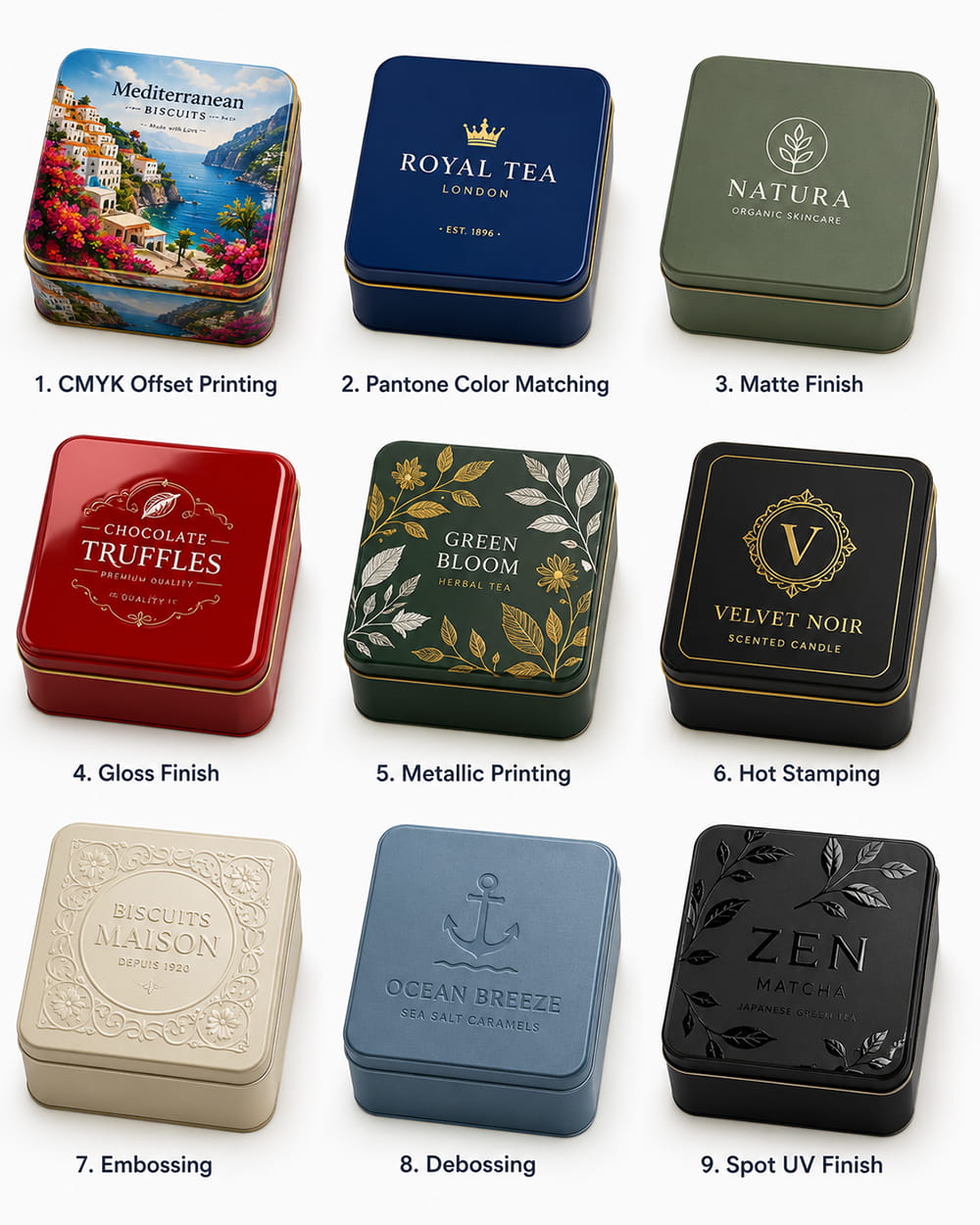
Choices vary with different brand positions.
| Brand Position | Better Design Direction |
| Luxury product | Matte finish, dark colors, embossing, metallic accents |
| Festive product | Glossy finish, bright colors, seasonal illustrations |
| Natural product | Soft colors, botanical design, minimal printing |
| Children’s product | Playful shape, strong color, character graphics |
| Corporate gift | Clean logo placement, inside message, refined finish |
| Promotional item | Standard mold, simple printing, cost-effective branding |
| Collectible product | Custom shape, embossed details, limited-edition artwork |
There are too many effects and the tin looks crowded, as well as being more expensive.
It is better to select one or two design elements that clearly support the brand.
Most buyers look at the outside of the tin. But the inside usually determines if the packaging works.
Internal structures can be:
These parts help solve actual problems in packaging:
For instance:
Even a pretty custom tin with the wrong inner structure can fail after shipping.
One of the most important choices in custom tin packaging is whether to use an existing mould or to create a new mould.
Existing Moulds
Existing moulds are generally better, when:
Benefits include reduced tooling cost, reduced lead time and project risk.
New Mould
New moulds are better when:
New moulds can give more distinction but add to cost, sampling time and production complexity.
A practical rule is simple.
Test and launch on existing moulds. When the product line is stable enough to justify the investment, use custom moulds.
Custom tin packaging projects often get into trouble, not because the concept is bad, but because the details are not checked early enough.
Tin boxes are three-dimensional. When creating artwork, think about curves, seams, edges, embossed areas, lid overlap and cutting lines.
A design that looks good on a flat screen may not line up correctly after forming.
Metal printing may behave differently than paper printing. Final colour is affected by Pantone matching, varnish, metallic effects and tinplate background
Pre-production samples are important if colour accuracy is important.
Fine lines, small text or intricate artwork may not emboss well on metal. Design embossing considering manufacturing constraints.
Drawing with a tin is fine, but not for real product. Always check product fit, lid clearance and inner tray thickness.
If a tray, divider or pouch is required, it should be included in the early size decision. Otherwise there may not be enough usable space in the last tin.
Weak export packing can scratch, dent or deform tin boxes. Plan carton layout, dividers, polybags and stacking method before shipment.
“Successful projects need not only creative design but production discipline.
Custom tin packing is very common, but each product category needs a different logic.
Common Tin Type Key Decision Industry
| Industry | Common Tin Type | Key Decision |
| Tea packaging | Round tins, square tins, canisters | Aroma protection and shelf presentation |
| Coffee packaging | Canisters, gift tins | Freshness support and premium image |
| Cookie packaging | Large rectangular or round tins | Breakage protection and gift value |
| Candy packaging | Mini tins, sliding tins, hinged tins | Portability and repeat opening |
| Chocolate packaging | Gift tins, heart tins, window tins | Inner trays and seasonal appeal |
| Cosmetic packaging | Small round tins, screw lid tins | Hygiene, leakage control and portability |
| Candle packaging | Round candle tins | Heat stability and decorative value |
| Gift packaging | Hinged tins, custom shapes | Reusability and emotional value |
| Promotional packaging | Standard tins, mini tins | Logo visibility and cost control |
And this industry logic prevents buyers from buying a tin because it looks attractive.
The right tin should align with the product category and customer usage. Once the product requirements, tin structure, lid type, and production feasibility are clear, brands can move into the visual direction of the package. For more ideas on color, finish, reusable design, collectible series, and category-specific design styles, see our guide to:
Instead of simply asking “How much is this tin?,” buyers can create a more useful supplier brief.
A good brief for custom tin packaging should include:
Such a short helps the supplier to recommend a realistic tin structure faster and more accurately.
It reduces repeated revisions too.
Buyers can go through five checkpoints of the project before confirming custom tin packaging.
Decision Area, Key Question
| Decision Area | Key Question |
| Product fit | Does the tin fit the real product, insert and lid clearance? |
| Protection | Does the structure protect against the main risks? |
| User experience | Is the lid easy and suitable for repeated use? |
| Brand message | Do shape, printing and finish support the product positioning? |
| Production reality | Are mold, MOQ, sample time, cost and packing acceptable? |
If one of these areas is weak the project should be adjusted before mass production.
Custom tin packaging works best when the final design is not only eye-catching, but also practical, manufacturable and appropriate for the product’s actual journey.
Custom tin packaging is a metal tin container that is customised in shape, size, lid type, printing, finish, coating, inner structure or mould design to fit a particular product and brand.
Yes, custom tins are very popular for tea, coffee, cookies, candies, chocolates and other food products. However, food-contact requirements, inner coating, liners, trays or pouches should be confirmed depending on product and target market.
Existing moulds are often better for new brands, lower budgets and faster launch schedules.” Custom moulds work better for high volume products, long term product lines or packaging that needs a unique brand shape.
The main cost factors are tin size, shape, mould selection, lid structure, printing method, finish, embossing, inner tray, order quantity, sample requirements and packing method.
Yes. Common options include CMYK offset printing, Pantone colour matching, screen printing, metallic printing, hot stamping effects and inside-lid printing.
Not necessarily. However, trays, dividers, liners or pouches are often necessary for fragile, premium, multi-piece or gift products to enhance both protection and presentation.
Yes. One benefit of tin packaging is that consumers often reuse tins for storage, gifting or decoration after the product has been used.
Use of existing tooling, standard shapes, functional finishes, fewer colours, simple construction and early production planning. Avoid unnecessary custom closures, oversized tins, and complex tooling unless they are supporting clear product or brand value.
Shape and decoration alone should not be the starting point of custom tin packaging. It should start with product requirements.
A good tin packaging solution answers several questions simultaneously:
When made together these decisions make a custom tin more than a container. It becomes a functional metal packaging solution that protects the product, supports the brand and provides the customer with a reason to keep it.”
Obtenga la información más reciente y ofertas especiales


 Soporta red IPv6
 Español
 English
 Français
 Deutsch
 Português