
Launching a private label collection is so much more than just a logo on a standard rolling tray.
A good collection has a defined customer, a manageable number of products, a consistent visual language, appropriate tray structures and a price hierarchy that is easy for the customer to grasp. When you put all these elements together, rolling trays become an identifiable piece of the brand, not just another generic promotional item.
This guide illustrates how accessory brands, lifestyle retailers, smoke shops, distributors and wholesale buyers can develop a targeted private label rolling tray collection without over-committing inventory or complicating production.
Usually, the artwork is the coolest part of a custom rolling tray project, but it shouldn't be the first thing you decide.
The first step is to understand who is going to buy the product, and why they would want it. The everyday tray that a cost-conscious customer wants will be different from what a collector, a gift buyer, a premium lifestyle customer or someone looking for a compact, portable product wants.
A retail product that is price sensitive might use a standard open structure, popular sizes, energetic artwork and simple packaging. A premium collection might require thicker tinplate, more muted graphics, metallic details, a magnetic lid and a retail box.
The more you understand your target customer, the easier it will be to select the right size, structure, finish, packaging and retail price.
Rolling tray collections for private label can be developed as a regular retail line, a promotional product, a gift set component or a limited edition.
A retail collection should have enough variety to invite customer choice, but not so many similar products that they are hard to manage in the store. Promotional trays tend to focus on visible branding, accessible pricing and efficient bulk packing. Gifts need to be presented better, packaged better and perceived as being better value.
Limited-edition collections are something else. They can tie into seasons, work with artists, number their designs or limit production to create scarcity. In these projects the story behind the work of art can be as important as the tray itself.
Before choosing designs, a brand needs to understand the commercial function of the collection. Or the end results might be pretty, but have no real purpose.
A private label collection can include small, medium and large rolling trays. However, a new brand doesn’t have to launch every size all at once.
For most first orders it is more practical to choose one main size. It makes sampling, pricing, photography, packaging, inventory management and repeat orders easy.
| Tray size | Main positioning | Key advantages | Points to consider |
| Small | Entry-level, promotional or portable product | Lower material cost, compact packaging, easy to carry and suitable for gift sets | Less working space and a smaller artwork area |
| Medium | Core retail product | Balanced size, strong artwork visibility, practical for regular use and easier to display | Usually the safest option, but still needs clear visual differentiation |
| Large | Premium or statement product | Strong shelf presence, more working space and greater impact for detailed artwork | Higher material, carton, storage and freight costs |
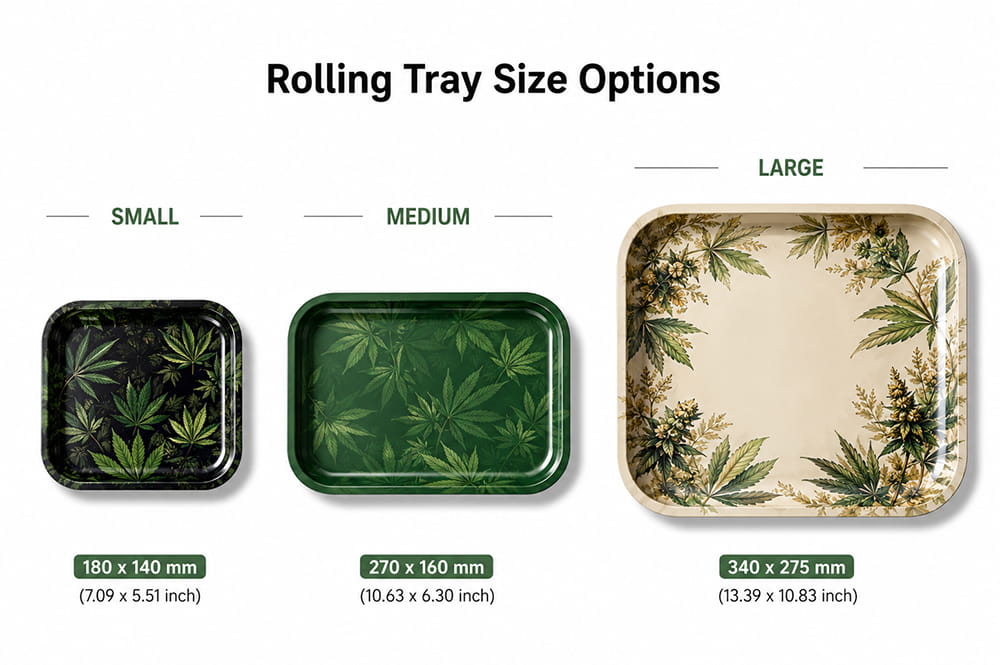
A medium rolling tray is the ideal hero product for many brands. It is practical enough for retail display and international shipping, yet has enough space for detailed printing.
Large rolling trays can support a premium price point. Small rolling trays can be added later as an entry level option. This allows for a natural expansion path and avoids the brand starting with too many SKUs.
Collections can get complicated very quickly.
Three tray sizes and four artworks already give twelve individual products. Each product must be artwork approved, identified for production, tracked in inventory, photographed for retail, barcoded, packaged, described in sales, and re-ordered.
The first launch is often easier to manage with one medium size and three coordinated artworks than with multiple sizes and unrelated graphics. Another practical possibility is to offer a hero design in two sizes, or to combine a standard open tray with a premium magnetic lid version.
The idea is not to make the collection appear large. The aim is to make it simple for customers to understand and simple for the business to stock.
Standard open trays and magnetic lid trays are not interchangeable versions of the same product. In a collection they occupy different places.
An open rolling tray is simple, stackable, and reasonably economical. It is effective for regular retail products, promotional programs, multi-design collections and price-sensitive markets.
A magnetic lid enhances portability, storage value and provides another printable surface. This also adds a sense of completeness and makes it more ideal for gifting, premium retail, limited editions or coordinated artwork on the lid and tray.
The lid has to be integrated into the product concept, not just thrown on because it looks more advanced. One approach that can be taken is to maintain the open tray as the base item and launch the magnetic lid version as a visible premium upgrade.
One of the biggest mistakes in private label product development is selecting a few attractive artworks that don’t appear to be connected.
Each design looks good individually but when combined the products can feel like they come from different brands. A stronger collection has a common visual language.
This connection can be made by using a consistent color palette, type, border style, logo placement, illustration style, background pattern or surface finish. The central artwork can be changed, but the overall visual language is still recognizable.
For example a collection could have the same layout with multiple colorways. Another series could have different subjects, but in the same style. A collection that is more story-centric might tie each design together through a common theme like cities, seasons, music, botanical imagery, geometric art, or retro travel graphics.
The designs do not have to be the same. They just have to feel they are in the same brand world.
More art doesn’t necessarily mean more sales.
Each new design increases prepress, color approval, sorting, packaging identification, photography, listing management, inventory risk and reorder complexity.
In many first collections, three to five coordinated artworks are enough variety to test customer response without having the order spread too thinly. One generally attractive design, one visually bold design, one premium/minimal design and one seasonal/experimental design might make for a balanced launch.
The structure provides the brand with valuable sales data. Strong designs can be expanded to new sizes, magnetic lid models or matching gift sets later and weak designs can be discontinued without excess inventory
When working with wholesale buyers, always ask if the minimum order quantity is for the entire project, or each individual artwork.
It’s not the same to produce 1,000 trays with one design as it is to produce 1,000 trays divided across ten designs. Each artwork may require different file creation, print setup, color check, sort, quality control and identification of packaging.
MOQ starts from 1,000 pieces as standard, but the real requirement depends on tray size, structure, number of designs, printing process and packaging plan.
A clear request should specify both the overall amount and the amount required for each artwork. This allows the manufacturer to create an accurate production plan instead of a misleading initial price.
The private label product should be clearly part of the brand, but the logo does not always have to be the dominant feature of the whole tray.
A retail item with big branding can look like a free promotional handout. For products the consumer is expected to buy, the artwork is supposed to create desire, while the logo is the stamp of ownership.
A small logo near the bottom edge or subtle branding worked into the illustration, a repeated symbol within the border or brand information printed on the reverse side all work well. Magnetic lid products can show the main brand identity on the outer lid, with more expressive artwork inside the tray.
Retail sleeves and individual cartons also give additional space for logos, product names, barcodes, collection stories and company information. This means the tray itself can stay visually attractive, without losing brand recognition.
“If customers can see right away why one model is more expensive than another, then it is easier to sell a private label collection.
A basic product may be small or standard medium in size, open in structure, printed in standard CMYK and packed in a basic polybag. The core product can be medium sized, more refined in design, with balanced material thickness, matte or glossy finish, and branded sleeve or carton.
The premium product must offer real and functional differences. These can include a magnetic lid, thicker tinplate, metallic printing, embossing, interior artwork that matches or gift-ready packaging.
Weak positioning happens when you raise the price, but don’t change the experience. The customer should be able to see & feel the difference before reading the specs.
Graphics alone don't make the game feel premium.
Material thickness, edge forming, coating, structure, colour direction, print finish and packaging influence the perception of the tray. A simple design on heavier tinplate, with a matte varnish and a few metallic highlights, can feel more premium than a very complex illustration on a lighter structure.
An entry level product might have simpler packaging and more vibrant graphics. The premium versions can have controlled colours, tactile embossing, a magnetic lid and an individual retail box.
The whole product should be speaking one position. Jarring can be an inexpensive looking structure combined with an artwork that’s trying to be luxurious.
Packaging should be part of the product development process—not something to be considered after the trays have already been produced.
Bulk packing is suitable for distributors who intend to repack the products locally. It lowers packaging cost but offers little retail protection. Individual polybags protect printed surfaces from dust and light scratching and are practical for standard wholesale programs.
Paper sleeves convey brand information without hiding the majority of the tray. They can include a product name, barcode, the story of the collection, care instructions and company info. The individual cartons offer better protection and are more suitable for online sales, gifting or higher retail prices.
Premium programs can also include the tray along with related accessories in a custom gift box. Paper, foam, PET or molded inserts hold products securely in place and enhance presentation.
Packaging must support the product position. A loose unbranded polybag can really diminish the value of a premium magnetic lid tray.
You can make a one-off product with a custom mold, but then you incur the cost, development time, and structural risk.
Often, for a first private label collection, it is more practical to use existing molds. The dimensions have been tested, the forming process is more predictable, sampling is faster and it is simpler to arrange replacement orders.
The only time new tooling is justified is when the brand needs a truly unique shape, proprietary dimensions, special compartments, a unique lid system, or some other feature that provides a clear retail advantage.
You might not add enough value to pay for the additional investment by tweaking a standard dimension a bit just so you can say it's unique.
A sample should not be treated as a single attractive tray.
Pull all the proposed products together and see if the colors, typography, logo placement, surface finish and packaging all feel connected. The visual difference in price between core and premium should also be understandable.
A collection may have several individually successful designs, yet look inconsistent when put on the same shelf. Look at the range as a system and you can spot weak artwork, inconsistent branding, unclear positioning and unnecessary SKU overlap before you go into mass production.
The right launch model depends on the brand’s experience, its customers and its inventory capacity.
| Collection model | Recommended structure | Best suited for |
| Focused first launch | One medium open tray, three coordinated artworks and one packaging format | New brands testing demand with lower inventory risk |
| Good, better, best | Small open tray, medium open tray and medium magnetic lid tray | Brands that need clear entry, core and premium price levels |
| Collectible design series | One tray size with four or five connected artworks and coordinated packaging | Design-led brands, artist collaborations and limited-edition releases |
The focused first launch is often the safest place to start. That makes the product range easy to manage and gives clear sales data.
The good-better-best structure creates a strong retail price ladder, but requires more planning for inventory. A collectible series can drive repeat business, but it depends on visual identity and story-telling to be successful.
One of the biggest risks is to launch too many sizes and designs at one time. It breaks up the order quantity, adds complexity to production and can result in the brand having slow moving inventory.
Another common mistake is selecting artwork that does not share a creative direction. Good quality illustrations can even be detrimental to the collection if the products do not appear to be related.
Brands also shouldn’t build the whole thing around the logo. A retail tray must be attractive enough to stand on its own. The branding should support the product, not replace creativity.
Premium buildings need premium presentation. Magnetic lid or thicker tinplate alone does not create a high-end product if the artwork, finish and packaging are basic.
Think about copyright and trademark risks from the outset. Do not reproduce popular characters, entertainment logos, sports graphics or other recognizable artwork without permission. Original artwork offers the brand more control and a collection that can be safely grown over time.
The brand should be able to clearly explain before production is approved, who the target customer is, how the trays will be sold, what the target retail price is, which size will be the hero product and if a magnetic lid is commercially necessary.
Also to be confirmed are the number of designs, quantity per artwork, logo placement, packaging format and the visual link between the products. Buyers should consider the appropriateness of existing moulds to the project requirements and which items are most likely to be repeat orders.
Decisions made clearly at this stage will make quotation, sampling, production and future re-ordering more efficient.
A strong private label rolling tray collection is not defined by how many products it has. The position of the products defines its clarity.
Customers need to be able to see who the collection is for, how the designs relate and why one product has more value than the other.
For most new wholesale programs, one hero size, several coordinated designs and one clear premium upgrade provides a stronger foundation than a large and complicated first launch.
Begin with a narrow offering, use sales to pinpoint the best designs, then broaden into more sizes, magnetic lid structures, gift sets or seasonal launches.
The rolling tray is the ultimate private label product when size, structure, artwork, packaging and price all convey the same brand position.

Obtenga la información más reciente y ofertas especiales


 Soporta red IPv6
 Español
 English
 Français
 Deutsch
 Português