
When developing tin candy boxes, opening mechanisms are often discussed late in the design process.
In practice, however, closure design is one of the earliest decisions that shapes overall packaging performance.
From moisture control and child safety to consumer handling and recyclability, innovative opening mechanisms in tin candy packaging directly influence how a product performs on the shelf, during transportation, and in everyday consumer use.
Based on recent confectionery packaging projects across different markets, the following tin candy box opening mechanisms are among the most practical and frequently requested today — not because they look new, but because they solve real packaging problems.
A screw lid tin candy box uses threaded engagement between the lid and the body to achieve opening and closure. Threads can be formed on the tin body or integrated into the lid, depending on the structural design and usage frequency.
This type of opening mechanism is designed for repeated use and consistent sealing rather than visual impact.
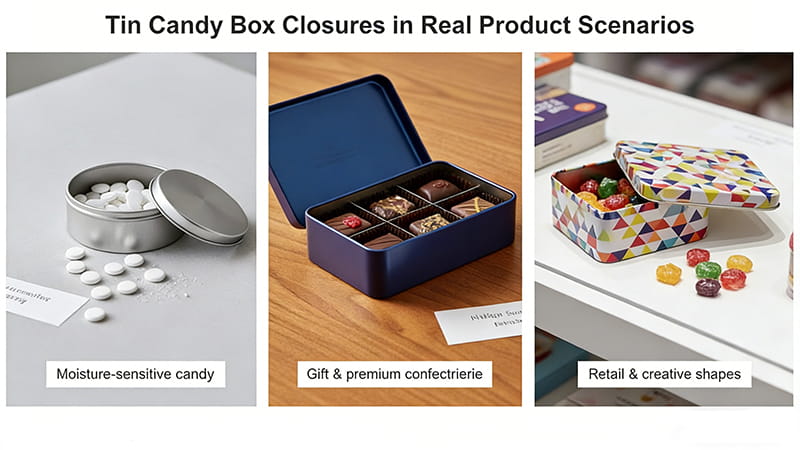
The primary advantage of screw lid tin candy boxes is moisture protection.
Products such as mints, chewing gum, functional lozenges, and medicated hard candies are highly sensitive to humidity. Even minor moisture exposure can affect texture, taste, and shelf life.
A properly engineered screw lid, especially when paired with a sealing ring, provides strong physical locking force and significantly reduces moisture ingress. This also improves portability, as the lid is unlikely to loosen accidentally in pockets or bags.
From a consumer perspective, screw lid tins are frequently reused after the candy is finished, adding long-term brand exposure through secondary use.
Application insight:
In a recent project for a European functional candy brand, a screw lid tin was selected to address humidity issues during long-distance distribution. By fine-tuning thread tolerance and incorporating a customized sealing liner, the packaging achieved improved moisture resistance, helping extend shelf stability by approximately 30% under standard storage conditions.
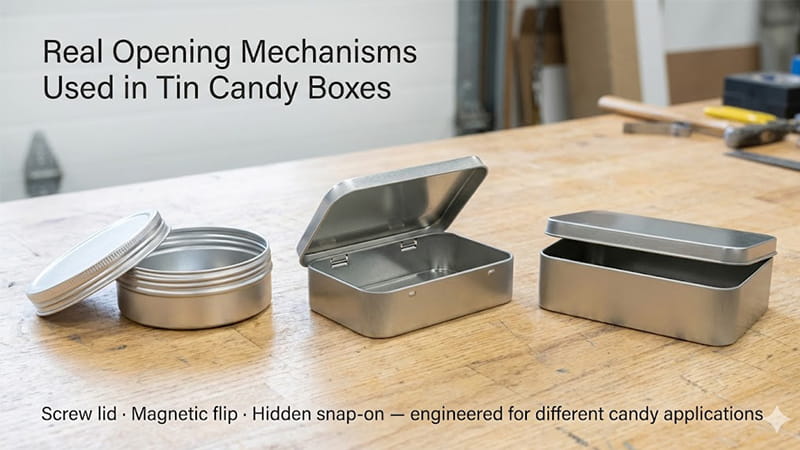
Side flip magnetic tin boxes combine a hinged opening with embedded micro-magnets positioned along the closing edge. The magnets are typically concealed within the rolled tin edge, allowing the exterior surface to remain visually clean and uninterrupted.
This opening mechanism requires precise control during manufacturing, particularly in hinge alignment and magnetic strength balance.
Magnetic flip closures are widely used in gift-oriented candy packaging, seasonal assortments, and premium chocolate tins. Their appeal goes beyond appearance.
The controlled resistance when opening and the soft “click” when closing provide tactile and auditory feedback that consumers associate with quality. In addition, magnetic tins can often be opened smoothly with one hand, improving user experience without sacrificing closure stability.
For brands targeting high-end retail or gifting occasions, magnetic tin candy boxes help reinforce product value at the moment of interaction.
Application insight:
For a seasonal chocolate gift program aimed at premium retail channels, a side flip magnetic tin was engineered to balance presentation and usability. Magnet strength and hinge geometry were adjusted to ensure smooth one-hand operation while maintaining consistent closure performance after repeated opening and closing cycles.
Hidden snap-on or inner click closures rely on the elasticity of tinplate combined with subtle internal locking points. These locking features are positioned inside the lid or along the inner rim of the tin body, remaining invisible from the outside.
As a result, the external surface remains uninterrupted, making this structure well suited for large-area printing and minimalist design concepts.
Compared with magnetic systems, snap-on tin closures are more cost-efficient to scale. The locking effect is achieved primarily through mold design rather than additional components, which supports stable mass production.
Hidden snap-on mechanisms are commonly used in creative-shaped candy tins, press-fit lids, and certain sliding or push-style designs, where visual simplicity and cost balance are priorities.
For brands positioned in mainstream retail channels, this opening mechanism often offers the best compromise between appearance, functionality, and production efficiency.
| Opening Mechanism | Core Advantage | Typical Candy Applications | Brand Positioning |
|---|---|---|---|
| Screw Lid | Moisture protection, durability | Mints, gum, functional candy | Professional, reliable |
| Side Flip Magnetic | Premium feel, one-hand opening | Gift chocolates, seasonal tins | High-end, innovative |
| Hidden Snap-On | Clean appearance, cost balance | Creative shapes, retail candy | Modern, design-focused |
| Push-to-Open | Interaction, ease of use | Kids candy, tablets | Playful, engaging |
| Sliding Lid | Compact, familiar | Coffee candy, mini lozenges | Classic, portable |
In real projects, closure selection rarely starts from design preference alone. Buyers typically narrow down options by aligning three practical factors early on.
Product behavior comes first. Moisture-sensitive candies require stronger sealing performance, while dry or individually wrapped candies allow greater flexibility in closure choice.
Target market requirements often define the boundary. In North America, child-resistant opening mechanisms are increasingly relevant for functional or supplement-based candies. In contrast, European buyers frequently prioritize recyclability and plastic-free packaging structures.
Sales channel expectations further refine the decision. Gift-oriented tins emphasize presentation and user experience, while mass retail packaging focuses on cost stability and production efficiency.
When these three factors are clear, the appropriate tin candy box opening mechanism usually becomes evident before decoration or artwork is finalized.
In markets such as North America, opening mechanism design is increasingly influenced by safety and compliance considerations.
For candies containing CBD, melatonin, or high-dose vitamins, child-resistant closures — such as push-and-turn or angle-dependent rotation systems — are often required.
Tin candy boxes can be engineered to support these safety requirements without relying on plastic components, making them suitable for brands balancing compliance and sustainability goals.
Sustainability discussions now extend beyond material selection to closure structure.
Metal-only opening mechanisms eliminate plastic inserts and mixed-material separation issues, allowing tin candy boxes to remain fully recyclable within existing steel recycling streams.
For brands actively reducing plastic use, closure design has become a critical part of packaging strategy rather than an afterthought.
Innovation in tin candy box opening mechanisms is becoming increasingly purpose-driven. Rather than focusing on novelty alone, brands are evaluating how closure design supports product protection, regulatory expectations, consumer interaction, and recyclability at the same time.
As functional candies, premium gifting, and plastic-reduction initiatives continue to grow, closure design is now discussed earlier in the packaging development process — where it has the greatest impact on performance and cost control.
If your next candy product requires a tin packaging solution, defining product characteristics and target market expectations at an early stage allows opening mechanisms to be engineered more efficiently. This approach helps avoid redesigns later in production and ensures the tin candy box performs as intended throughout its lifecycle.

Obtenga la información más reciente y ofertas especiales


 Soporta red IPv6
 Español
 English
 Français
 Deutsch
 Português